
























































A Whitby Collegiate student has won a national innovation competition with a tool that gives teachers a clearer view of how students create their written work.
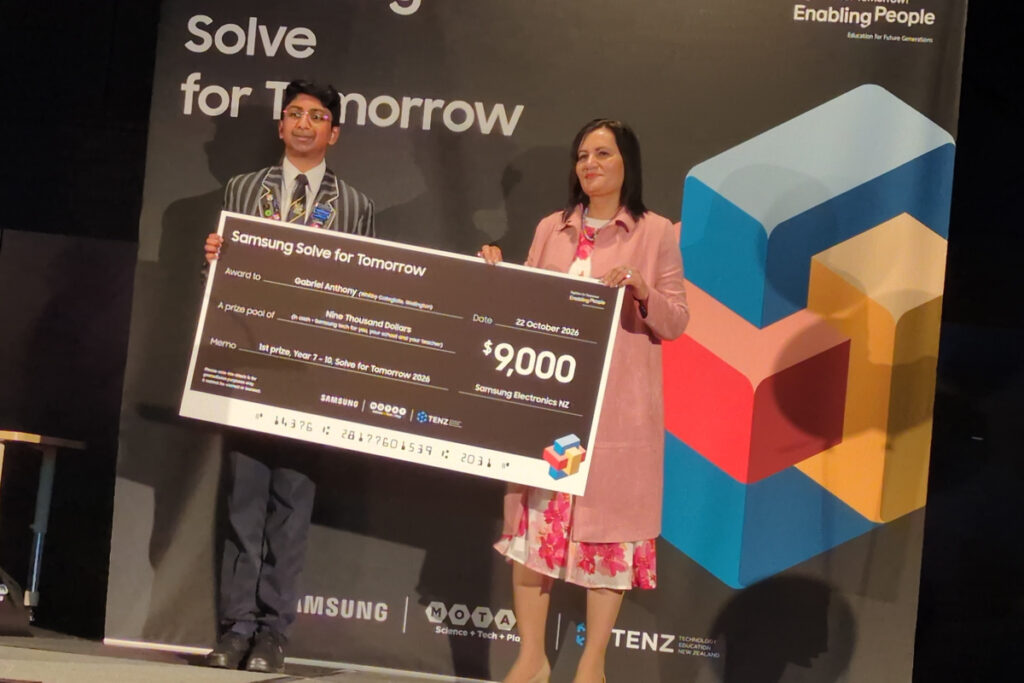
Gabriel Anthony, a Year 10 student at the Porirua school, took first place in the Years 7–10 category of the 2026 Samsung Solve for Tomorrow competition with Real Mahi.
The project addresses a question facing schools as generative artificial intelligence becomes more widely used: how to assess a student’s work when the finished text does not show how it was produced.
Real Mahi records typing, pasting and editing, giving teachers evidence of how a piece of writing developed. It is designed to support their assessment and professional judgement, rather than act as an AI detector.
Gabriel interviewed teachers and tested the tool with them, refining it in response to their feedback. Teachers and students from Whitby Collegiate were among those who contributed to its development.
Deputy principal (academics) Debbie Mitchell recognised the work behind the project in the school’s newsletter.
“It has been an honour to watch him develop this project, and see the real-world applications.”
The first-place award brings a $9,000 prize pool of cash and Samsung technology for the winner, their teacher and school.
Run by Samsung in partnership with the Museum of Transport and Technology and Technology Education New Zealand, the nationwide competition challenges students in Years 7–13 to use science, technology, engineering, arts and mathematics to solve problems in their communities.
Entries are assessed on community relevance, feasibility, creativity, presentation and how they apply those disciplines.
For Gabriel, the result follows earlier work on a problem much closer to home.
He won the same age category in 2024 with Pill-Bot, an invention inspired by his grandmother’s experiences. It was designed to help people with impaired vision identify medication, using artificial intelligence to recognise pills and announce their names.
In 2025, he received a highly commended award for Pill AI, which built on that earlier project with medication identification, reminders, voice input and language translation.