
































































Porirua Community Views
By David Christensen, Porirua resident
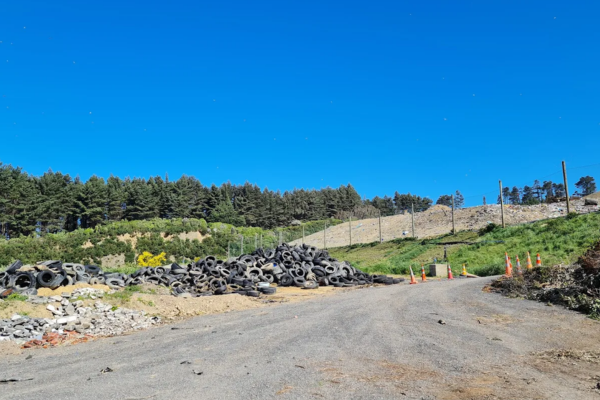
There is, at the heart of the current debate about Spicer Landfill, a question so obvious it has achieved the rare political feat of becoming almost completely invisible.
It is this: where will Porirua’s waste go?
This question has been treated with great seriousness. Entire documents have been written about it. Options have been carefully constructed, labelled, consulted on, and arranged into tidy sets for public consumption.
Some involve continuing to use Spicer.
Some involve sending waste somewhere else.
All of them involve, in one way or another, moving large quantities of unwanted material from one place to another and feeling quietly pleased that a decision has been made.
Which is, on the face of it, entirely reasonable.
Except for one small detail.
They all begin with the same assumption: the waste exists. The only question is where to put it.
And that assumption, polite, practical, and widely accepted, may also be the problem.
Because there is another question. A slightly less convenient one. The kind of question that does not often get invited into structured consultations because it has a habit of rearranging the furniture.
How do we reduce the amount of waste that needs to go anywhere at all?
Not as a distant aspiration. Not as something we nod to in strategy documents before returning to the important business of deciding where to send the trucks.
But as a real, practical, slightly uncomfortable plan.
To be fair, Porirua City Council is not unaware of this idea.
If you read its Long Term Plan, you will find repeated references to waste minimisation, environmental outcomes, long-term thinking, and working with others to achieve better results.
In other words, the idea is already there.
What is less obvious is how that idea translates into the decision currently in front of council.
Because when you look at the options being considered, something curious happens.
The ambition quietly disappears.
Instead, the focus narrows to extending the landfill, closing the landfill, or sending waste elsewhere.
All are valid. All may be necessary.
But all operate within the same underlying system.
It is, in effect, a thoughtful discussion about how best to continue doing what we are already doing.
There are hints of something more.
One option creates breathing space. Another begins to build capability in reducing waste.
These are sensible ideas. The kind that make you feel progress is being made.
But they remain improvements within the system. They do not yet answer the larger question.
Which brings us to something not currently on the table in any meaningful way.
Let’s call it Option G.
Not because it is necessarily better, but because it is largely missing from the list of options in the council’s consultation document.
Option G starts from a different premise.
It suggests Spicer Landfill is not just a problem to be solved, or a liability to be managed, but an asset that could be used temporarily and carefully to enable a transition.
A transition toward a system where more materials are sorted and recovered, more waste is diverted before it reaches landfill, useful resources are extracted rather than buried, and the volume of waste requiring disposal declines over time.
It also suggests Porirua does not exist in a vacuum.
Waste flows, infrastructure, funding, and markets operate at a regional and often national level. Making a long-term decision in isolation may not be the best outcome.
Option G is not a demand to abandon existing options.
It is not a fully costed plan.
And it is not a magic solution where all waste disappears.
What it is, is a pathway.
A way of connecting the useful elements already on the table into something that leads somewhere.
Because without that connection, those elements risk becoming what local government occasionally excels at: well-intentioned improvements that leave the underlying system largely unchanged, and a large bill for ratepayers.
So the question becomes simple, not in the sense of easy, but unavoidable.
Before making a long-term decision about where the waste will go, should we test whether there is a credible pathway to needing less of that decision in the first place?
This is where things become uncomfortable.
If you return to the Long Term Plan, Option G does not look like a radical departure.
It looks like a logical extension.
Which raises a fair question.
If this direction is already embedded in council strategy, why is it not reflected in the options being considered?
This is not an accusation.
Simply a matter of curiosity.
Because once a decision is made, whether to extend, close, or export, it shapes everything that follows.
Funding flows in that direction. Infrastructure develops around it. Alternatives become harder, then unlikely, then forgotten.
And years later, someone inevitably asks: did we ever properly look at whether there was another way?
This is not a call for delay.
It is a call for completeness.
Before locking in a long-term answer to where the waste will go, we should take a serious look at how to reduce the need for it to go anywhere at all.
Because if that question is worth asking, and council’s own strategy suggests that it is, then it is worth answering before the trucks start moving.
Endnote
David Christensen is a Porirua resident with a background in systems thinking and long-term infrastructure analysis. He has made a submission on the future of Spicer Landfill.