



























































Report and photos by Roy Murphy
The organisers of the Porirua Citizens Assembly on Climate Change have delivered a comprehensive Toolkit of how a more thorough democratic process can be, and should be undertaken. The 15-page preface meticulously lays out how the Assembly was set up, and a 14-page report demonstrates and reflects on the success of the Assembly and the implications going forward.
These closely argued and detailed reports were presented at a public Zoom seminar on Wednesday afternoon. They provide a blueprint for future action.
The primary impetus for this mostly volunteer work was to find a better way to organise a democratic society. It states:
“Our government system was designed to keep people out and continues to function accordingly. All this and more has led to distrust and cynicism in the political process.”
It lists many ways that the current practice of democracy fails, a major one being that adversarial politics are often reduced to petty behaviour and “sees public resources wasted at huge scales”. Democracy is reduced to entering an X in a few boxes, and then you have to wait three years before you can do it again.
“Currently, it is rare for there to be opportunities for everyday people to participate in collective decision-making.”
This is why it emphasises building on Te Tiriti o Waitangi, saying it offers pathways for “more equal and participatory processes, decision-making grounded in collaboration and wellbeing rather than adversaries and extraction, and a commitment to future generations embedded in how power is exercised.”
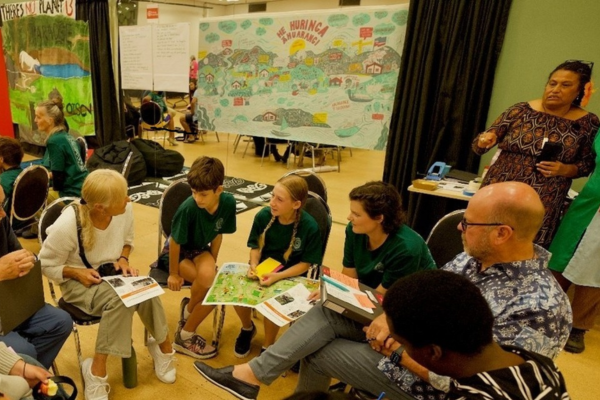
It asserts that the Porirua Citizens Assembly on Climate Change held last year shows a clear path forward for decisions to be made quickly and with broad agreement by a diverse group of community members. The discussions included consideration of indigenous rights and the rights of children.
The deliberation process enables a large group of ordinary people to talk, be listened to, and work out a way of coming together to achieve a common goal.
The Porirua Assembly showed this can be done. The Assembly set a standard of at least 80 percent approval of any proposal. In the event, they attained 100 percent approval.
Local community leaders in Porirua got together to form the Community Leaders Forum to make sure that the Assembly’s work was followed up.