



















































A Ngāpuhi father who fought to secure citizenship for his overseas-born children says support from Porirua Whānau Centre helped his family rebuild their lives in Aotearoa.
John Ruddock brought his three children to New Zealand believing his citizenship would allow them to become citizens too.
Instead, he found there was no automatic pathway for them.
“When I came, I was informed that I couldn’t get them citizenship,” John said.
“I was trying to go through all the pathways through immigration, but there was none set.”
John’s mother, singer Rhonda Bryers, was known as “The Voice of New Zealand”. He was born overseas while she was touring and grew up believing he was a citizen by birth.
“My mum had told me that I was always a citizen by birth. So, in my head, I thought I’d never have these problems.”
John was raised mostly in Hawaii and later had children of his own.
During the COVID-19 pandemic, the family moved to Washington State, where John ran a food truck business.
After his relationship ended, he brought the children to Aotearoa.
Under the Citizenship Act 1977, citizenship by descent generally stops after one generation. This meant John’s children, who were also born overseas, had no automatic claim.
Without citizenship, they could not enrol in school.
John was raising the children largely alone, feeding the family on about $30 a week and fighting for custody through the Hawaii courts at the same time.
“I kind of just felt it was wrong that there was no pathway for tangata whenua.”
John said the issue was bigger than his own family.
His whakapapa includes his grandfather Ron Bryers, who played for the All Blacks in 1959, and his great-great-grandfather Mohi Tāwhai, who signed Te Tiriti o Waitangi.
In July 2025, John took his case to the Waitangi Tribunal and sought an urgent hearing.
The Tribunal found the children were suffering significant and irreversible prejudice because they could not attend school and had no certainty about their legal status.
Temporary student visas were later approved, allowing them to enrol while the wider citizenship issue remained unresolved.
The Tribunal’s report, He Tangata, he Whenua, found the Crown had breached several Treaty principles by failing to consult Māori about citizenship laws affecting tangata whenua born overseas.
John’s lawyers argued for a dedicated tangata whenua pathway that recognised whakapapa rather than relying only on place of birth or a single generation of citizenship by descent.
While the legal fight continued, John’s situation reached a low point.
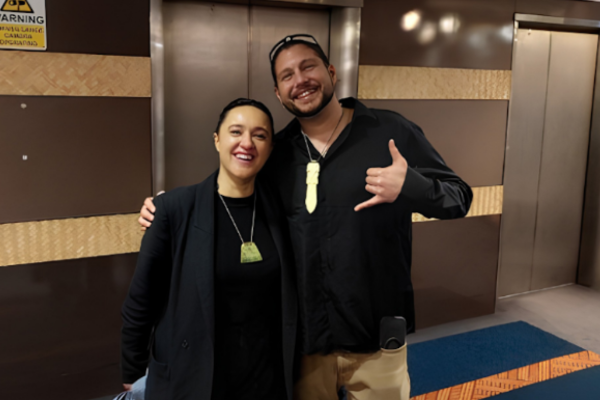
His story received media attention and Jessica Te Huia from Porirua Whānau Centre contacted him directly.
“She reached out to me and offered quite a bit of help to get us through all this.”
Jessica worked with John to identify what the family needed and helped them secure stable housing.
“We got our own place. Literally, in one day, we got a place. That was a huge, huge help.”
For John, having a home gave the family the stability they needed to deal with everything else.
Jessica also connected him with the Whānau Centre’s Mana Tāne group.
John said being a full-time single parent made it difficult to meet people, and the group gave him a chance to connect with other fathers, musicians and whānau.
“Being a full-time, single parent, it’s very difficult for me to go out and meet people. So, this was an awesome way that I could do that.”
By February, John had secured custody of his three children through the courts. They were later granted New Zealand citizenship and are now attending school.
“Ever since we moved to our own house, I’ve seen my kids just flourish,” he said.
“They love being amongst the culture. That’s all I’ve ever wanted.”
The children are learning karakia and kapa haka at school while also embracing the Samoan heritage they share through their mother.
“They come home with new karakia, doing kapa haka, speaking Samoan too. To me, it’s beautiful.”
John grew up around Hawaiian and other Pacific traditions but had limited access to his own Māori culture.
Returning to Aotearoa has allowed him to reconnect and learn alongside his children.
A year after arriving in Porirua, John is settled, working and raising his family.
He remains connected with Porirua Whānau Centre and is grateful for the support the family received.
“I still appreciate everything that Jess and the Whānau Centre did. It’s been really awesome.
“I want people to know that what they’re doing there is beautiful. I’m a great example of the results that can come from that kind of support.”
For John, the family’s return has also strengthened his connection to the whenua.
“I truly believe home is where you make it,” he said.
“All my ancestors are buried in this soil, so it’s always been home. I don’t think I’ve ever felt a connection to a whenua anywhere else like this.”