








































































Porirua households are expected to pay more next year despite Porirua City Council announcing an average zero per cent increase in non-water rates for existing ratepayers.
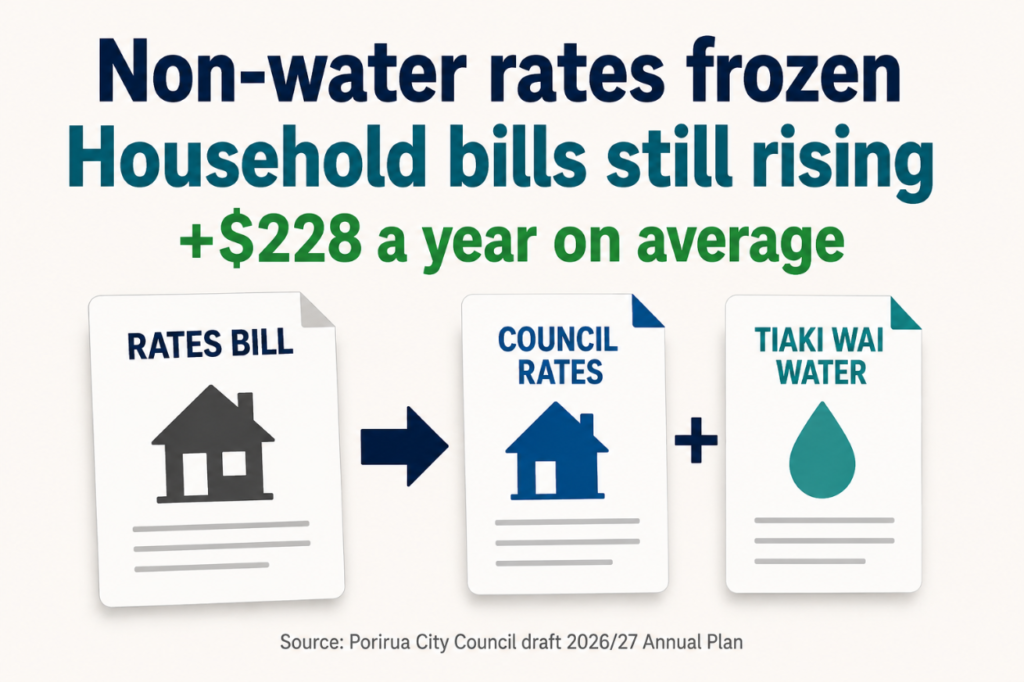
Council figures show the average residential household will pay about $228 more a year, or around $4 a week, once Porirua City Council rates, Tiaki Wai water charges and Greater Wellington Regional Council rates are combined.
The council’s announcement focuses on non-water rates, which are projected to remain unchanged on average in its draft 2026/27 Annual Plan.
However, that does not mean household costs are frozen.
Water charges are being removed from council rates bills and transferred to the new water entity Tiaki Wai, with residents expected to face higher water costs as investment in ageing infrastructure increases.
Mayor Anita Baker said the council had worked hard to avoid increasing non-water rates at a time when many families were under financial pressure.
“We’ve worked really hard to reduce costs wherever we can. We had predicted we would need to increase non-water rates but to now be able to land on a zero increase is a win for our communities at a time when everyone is feeling the pinch,” Baker said.
Baker said the council had achieved the outcome without cutting services or reducing maintenance work, while continuing to invest in essential infrastructure.
She acknowledged that household costs would still rise because of the need for increased spending on water infrastructure.
“The need for more water investment to fix the ageing infrastructure means that household costs will still increase, but with no increase to our council rates the impact on Porirua people will be much lower than originally thought,” she said.
The revised rates forecast follows the release of new Quotable Value assessments, which have changed how rates are distributed across the city. Council says utility properties recorded significant valuation increases while many residential properties declined in value.
Te Puna Kōrero Committee chair Josh Trlin said years of focusing on infrastructure investment and reducing council debt had helped improve the council’s financial position.
“We’ve made hard calls around investing in the most impactful and important infrastructure projects and reducing our deficit to achieve a balanced budget,” Trlin said.
Council is also projecting a balanced budget and says it will fully fund depreciation through rates rather than passing costs to future generations.
The draft 2026/27 Annual Plan will be considered for adoption at a full council meeting on 25 June.
While residents will not see an average increase in non-water rates, council projections show most households can still expect to pay more overall during the coming year.